Hybrid Solar Light Towers
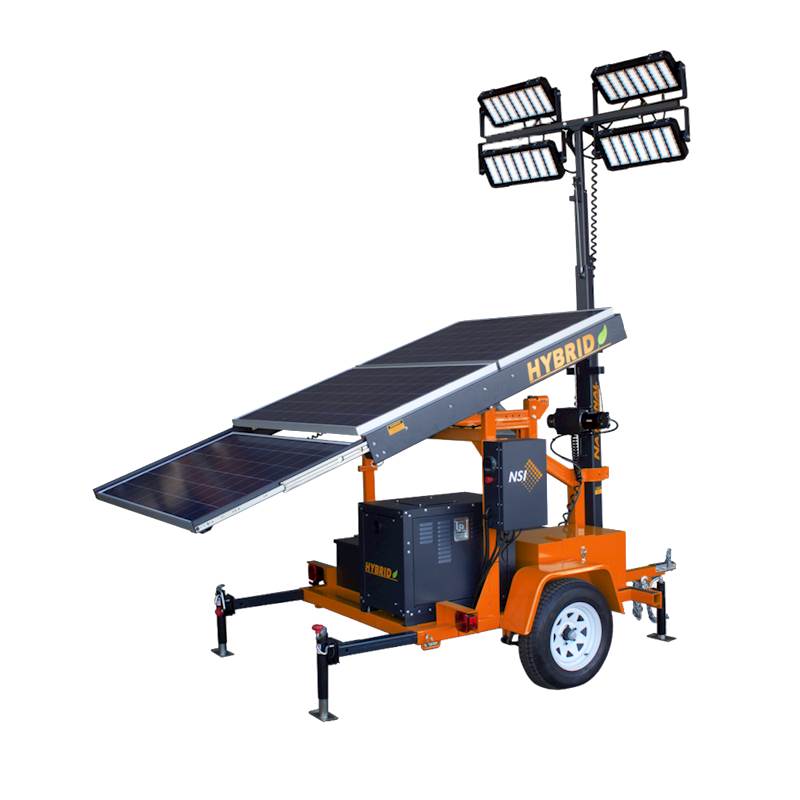
Solar Hybrid Light Tower for Sale: Sunray LTS-300H
The Sunray LTS-300H by National Signal is a portable solar and diesel hybrid light tower built for continuous nighttime illumination on construction sites, remote worksites, and emergency deployments. Three 330W photovoltaic solar collectors totaling 990W charge a 600 Ah AGM battery bank throughout the day. Four 240W dimmable LED fixtures draw from that battery bank at night, producing up to 163,200 lumens at full brightness and covering up to 48,229 square feet (1.107 acres) from a single unit position.
When solar input is insufficient to sustain battery charge, the onboard diesel generator activates automatically, supplements the battery, and shuts off once the charge threshold is restored. This demand-driven diesel operation keeps per-shift engine hours and fuel consumption well below those of a conventional diesel-only tower while maintaining uninterrupted lighting output regardless of weather or geographic location.
Advanced programmable scheduling, Dusk-to-Dawn mode, individual fixture control, and the proprietary Tilt & Point App for solar panel orientation give operators complete control over light output and timing with minimal manual management at the unit.
Request a quote on the Sunray LTS-300H
What Is a Solar Hybrid Light Tower?
A solar hybrid light tower uses photovoltaic panels as the primary energy source for an onboard LED lighting system. Solar energy collected during daylight hours is stored in a battery bank and discharged through the LED fixtures overnight. A diesel generator serves as a backup charging source, activating automatically when battery voltage drops below the operational threshold and shutting off once the battery returns to its target charge level.
This configuration produces fewer total diesel engine hours per deployment period than a conventional diesel-only light tower running over the same period. On days with adequate solar irradiance, the diesel generator may not activate at all. On overcast days or at sites with limited daily sun exposure, the diesel generator supplements the solar input to sustain full nighttime performance.
The Sunray LTS-300H is a solar-priority system. Solar energy drives the daily charging cycle whenever conditions allow. The diesel generator is a redundancy layer that maintains operational continuity when solar energy alone is not sufficient for the night ahead.
How the Sunray LTS-300H Charging System Works
The Sunray LTS-300H operates on a three-path charging model that prioritizes renewable input and uses diesel and shore power as supplementary sources.
Solar charging is the primary path. Three 330W collectors rated at 990W combined charge the 600 Ah AGM battery bank throughout the daylight period. The built-in Tilt & Point App guides operators through solar panel orientation during setup, maximizing daily energy harvest based on the unit's deployment angle and the sun's position. Proper panel orientation is the single most impactful setup step for reducing diesel generator activation frequency over the deployment.
Diesel generator charging is the secondary path. When battery charge drops below the system threshold, the diesel generator starts automatically to supplement the battery bank and restore voltage. The generator shuts off once the battery returns to its operational level. Engine operation is demand-driven, not continuous, keeping fuel consumption and engine hours significantly lower than a conventional diesel tower across the same illumination period.
Shore power charging is the third path. The built-in 40A, 24V AC charger with external receptacle allows the battery bank to be charged from a standard electrical connection at a yard, staging area, or facility. Shore power charging is used for pre-deployment preparation and scheduled maintenance intervals when the unit is not in the field.
Sunray LTS-300H Key Features
- Three 330W solar collectors producing 990W combined for primary daytime battery charging
- 600 Ah AGM sealed battery bank wired as a 24-volt system
- Automatic diesel generator activation and shutoff based on battery charge threshold
- Four 240W dimmable LED fixtures producing up to 163,200 total lumens at full brightness
- Three brightness settings: 163,200 lumens (100%), 108,800 lumens (67%), 54,400 lumens (33%)
- Maximum coverage area of 48,229 sq ft (4,480 m² / 1.107 acres) at full brightness
- Individual lamp control: each of the four fixtures can be turned on or off independently
- Each lamp turns and tilts 90 to 180 degrees for directional light adjustment
- Tilt & Point App for solar panel orientation to maximize daily energy harvest
- Advanced programmable daily and weekly scheduling, Monday through Sunday
- Light mode options: On/Off, Dusk + 3 hours, + 6, + 9, + 12 hours, and Dusk to Dawn
- 40A, 24V onboard AC charger with external receptacle for shore power maintenance charging
- Mast raises to 234 inches (approximately 19.5 feet) for elevated wide-area coverage
- Heavy-duty construction rated for continuous outdoor deployment
- Weight: 3,400 lb (1,542 kg)
Full Technical Specifications
Lighting Output
|
Specification |
Low (33%) |
Med (67%) |
High (100%) |
|
Lumens per Fixture |
13,060 |
27,200 |
40,800 |
|
Total System Lumens |
54,400 |
108,800 |
163,200 |
Maximum Coverage Area: 48,229 sq ft (4,480 m²) / 1.107 acres
Power Draw: 240 watts per fixture
Lamp Orientation: Each lamp turns and tilts 90 to 180 degrees
Individual Lamp Control: All four fixtures can be controlled independently
Light Scheduling and Control
|
Feature |
Detail |
|
Scheduling |
Daily and Weekly, Monday through Sunday |
|
Light Mode Options |
On/Off, Dusk + 3, +6, +9, +12 hours, Dusk to Dawn |
|
Timer |
Advanced programmable scheduling |
|
Solar Orientation Tool |
Tilt and Point App |
Power and Charging System
|
Specification |
Detail |
|
Solar Collectors |
Three 330W panels (990W combined) |
|
Battery Type |
AGM sealed, 24-volt system |
|
Battery Capacity |
600 Ah total |
|
AC Charger |
40A, 24V with external receptacle |
|
Diesel Generator |
Self-starting automatic start and stop with advanced engine control |
Physical Dimensions and Weight
|
Specification |
Detail |
|
Mast Height (raised) |
234 in (594 cm) / approximately 19.5 ft |
|
Deployed Footprint (L x W) |
135 in x 143 in (343 cm x 363 cm) |
|
Travel Dimensions (H x L x W) |
112 in x 145 in x 79 in (284 cm x 368 cm x 200 cm) |
|
Overall Width |
78 in |
|
Overall Length |
157 in |
|
Weight |
3,400 lb (1,542 kg) |
Specification note: Runtime performance varies based on daily solar irradiance, ambient temperature, brightness setting, and fuel quality. The Sunray LTS-300H is designed for continuous operation across all conditions through the combined solar, diesel, and shore power charging system.
Common Applications for Solar Hybrid Light Towers
Solar hybrid light towers are built for sites requiring reliable high-output nighttime illumination where fuel delivery access is limited, reducing engine emissions is a project requirement, or minimizing nighttime noise is a priority. The Sunray LTS-300H supports the following deployment types:
- Highway and roadway construction and maintenance operations where OSHA 29 CFR 1926.56 illumination minimums apply (https://www.osha.gov/laws-regs/regulations/standardnumber/1926/1926.56)
- Bridge and infrastructure projects with extended overnight lane closures and crew shifts
- Pipeline construction and utility corridor work in remote terrain with no grid access
- Emergency response operations, flood recovery staging, and disaster relief coordination
- Oil field and remote energy sector sites where daily diesel resupply is logistically constrained
- Public works projects in EPA air quality nonattainment areas where diesel emission standards restrict conventional tower use
- Outdoor events, festivals, and venue lighting in residential-adjacent or noise-ordinance environments
- Aggregate, mining, and quarry operations requiring sustained overnight shift illumination
- Military and government installations where fuel logistics are constrained and quiet engine-off operation during battery intervals is operationally important
Sites deploying the Sunray LTS-300H for area and perimeter lighting commonly pair the tower with additional traffic control equipment for complete job site safety configurations, including traffic cones and barricades.
Solar Hybrid Light Tower vs. Diesel-Only Light Tower
A conventional diesel light tower runs its engine continuously during operation to power LED fixtures directly. Fuel consumption is constant across every hour of operation, and engine hours accumulate at the full rate throughout every deployment.
The Sunray LTS-300H operates on a different energy model. Solar collectors charge the battery bank during daylight. The LED fixtures run from stored battery power overnight. The diesel engine activates only when battery supplementation is required, which on days with adequate solar input may amount to a brief charge interval or no engine operation at all.
The operational differences compared to a conventional diesel tower include:
- Lower total engine hours per deployment period because the engine does not run during battery-draw intervals
- Reduced fuel consumption per night of illumination when solar charging provides a significant share of the daily energy input
- Lower per-shift exhaust emissions, which is directly relevant on federally funded green construction projects and in EPA-designated nonattainment areas
- Lower ambient noise during engine-off intervals, important for urban work zones, residential-adjacent sites, and nighttime operations subject to local noise ordinances
Solar Hybrid vs. Diesel Battery Hybrid Light Tower
Both the Sunray LTS-300H and the LitePod Pro Li+ are hybrid light towers that reduce diesel engine runtime relative to a conventional diesel tower. They use different primary energy sources and are optimized for different site conditions.
The Sunray LTS-300H is a solar-priority hybrid. Three 330W solar collectors charge the 600 Ah AGM battery bank during daylight. The diesel generator activates only when solar input falls short. This design delivers the lowest diesel consumption on sites with strong, consistent daily solar irradiance: southern states, open terrain, warm-weather deployments, and projects with long daylight windows.
The LitePod Pro Li+ is a diesel battery hybrid. Its HATZ 1B30 PMGi Tier 4 Final diesel engine charges a 12V LiFePO4 battery on demand, independent of weather or sunlight. It performs consistently in high-latitude winter conditions, shaded environments, tunnel and underpass sites, and any deployment where a predictable solar charging window does not exist. In Hybrid ECO mode at 33% brightness, it delivers up to 1,275 hours per 39-gallon tank.
Choosing between the two products depends primarily on the site's solar availability, geographic location, seasonal daylight patterns, and fuel logistics constraints. For sites in sun-rich environments where reducing diesel use is the priority, the Sunray LTS-300H is the stronger choice. For sites where solar charging is unreliable or unavailable, the LitePod Pro Li+ provides more consistent and predictable runtime performance.
Compare this model with our non solar hybrid light tower.
Frequently Asked Questions About Solar Hybrid Light Towers
What is a solar hybrid light tower?
A solar hybrid light tower uses photovoltaic solar panels as the primary charging source for an onboard battery bank that powers LED fixtures overnight. A diesel generator serves as an automatic backup, activating when battery charge falls below the operational threshold and shutting off once the battery is restored. The solar-first design reduces diesel engine runtime, fuel consumption, and emissions per operating shift compared to a diesel-only light tower.
How does the Sunray LTS-300H solar and diesel system work together?
The Sunray LTS-300H prioritizes solar charging. Three 330W collectors charge the 600 Ah AGM battery bank throughout the day. At the programmed start time or at dusk, the four LED fixtures activate and draw power from the battery. If the battery drops below its charge threshold during the night or has not received sufficient solar input during the day, the diesel generator starts automatically to supplement the battery and shuts off once the battery returns to its target level. The system manages this cycle without operator intervention.
What happens if there is not enough sunlight to charge the panels?
When solar irradiance is insufficient to maintain adequate battery charge, whether due to overcast conditions, seasonal daylight reduction, or site shading, the diesel generator starts automatically to supplement the battery. The Sunray LTS-300H is designed for continuous uninterrupted operation regardless of daily solar availability. The diesel backup ensures consistent lighting performance across all weather conditions and geographic locations.
How many lumens does the Sunray LTS-300H produce?
The Sunray LTS-300H produces 163,200 total lumens at full brightness (100%) across four 240W dimmable LED fixtures, with 40,800 lumens per fixture. At 67% brightness, total output is 108,800 lumens. At 33% brightness, total output is 54,400 lumens. Reducing brightness extends the period the fixtures can run on stored battery power before the diesel generator is needed.
What is the maximum coverage area of the Sunray LTS-300H?
At full brightness, the Sunray LTS-300H illuminates up to 48,229 square feet (4,480 m²), equivalent to approximately 1.107 acres. Each of the four lamp fixtures can be turned and tilted 90 to 180 degrees independently for directional coverage, and individual fixtures can be turned on or off separately to concentrate light exactly where it is needed.
Can the lighting schedule be programmed on the Sunray LTS-300H?
Yes. The Sunray LTS-300H includes advanced programmable scheduling with daily and weekly settings across Monday through Sunday. Light mode options include On/Off, Dusk + 3, +6, +9, or +12 hours, and Dusk to Dawn. These settings allow a single operator to configure the full lighting schedule at deployment setup, eliminating the need for return visits to adjust the unit manually over the course of the project.
What is the difference between a solar hybrid and a diesel battery hybrid light tower?
A solar hybrid light tower, such as the Sunray LTS-300H, uses solar panels as the primary charging source and the diesel generator as backup. A diesel battery hybrid light tower, such as the LitePod Pro Li+, uses a diesel engine as the sole charging source with no solar input. The solar hybrid reduces diesel consumption most effectively on sites with reliable daily sunlight. The diesel battery hybrid delivers consistent charging and runtime regardless of weather or sun availability, making it better suited for winter conditions, shaded sites, and locations without a predictable solar charging window.
How do I request a quote on the Sunray LTS-300H?
Submit a quote request at https://www.trans-supply.com/app/support. Our equipment team will follow up with pricing, availability, delivery logistics, and specification support for your project requirements.
Request a Quote on the Sunray LTS-300H Solar Hybrid Light Tower
The Sunray LTS-300H is available for direct purchase and fleet-scale procurement through Trans Supply. Our equipment team supports single-unit and multi-unit orders with specification consultation, volume pricing, and coordinated freight delivery.
Submit your quote request.